


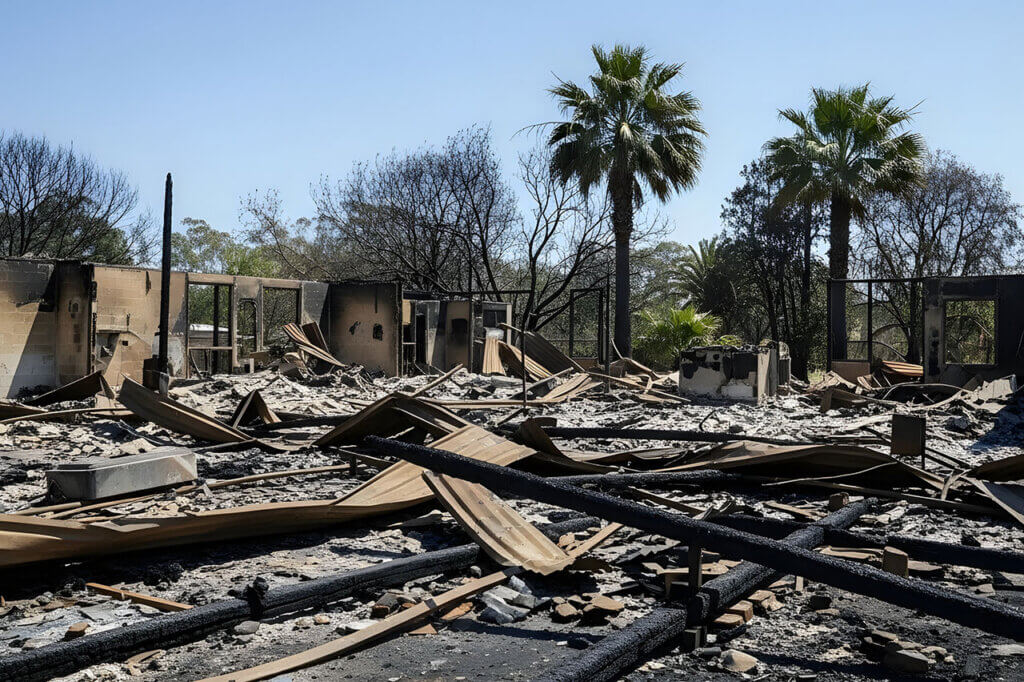
In September 2025, the California Earthquake Authority (“CEA”) was tasked with conducting a study and reporting on options to enhance the State’s natural catastrophe resiliency.[1] In April 2026, CEA released the Study Report,[2] which proposes three Policy Pathways for consideration by the Governor and Legislature:
- Pathway 1: Commit to Community Wildfire Risk Reduction
- Pathway 2: Equitably Allocate Catastrophe Burdens
- Pathway 3: State Roles for Addressing Catastrophe Resiliency
Each Pathway sets forth strategies and options to advance the State’s natural catastrophe resiliency goals, several of which would have significant ramifications for the insurance industry if implemented.
Pathway 1: Commit to Community Wildfire Risk Reduction
The first Pathway proposes an integrated approach to wildfire risk reduction in the face of potentially catastrophic conditions. Nearly a third of California residences are located within the Wildland Urban Interface (WUI), and of these, approximately 90% predate requirements mandating the use of fire-resistant materials and methods. Add in extreme wind events following periods of prolonged drought and, according to the Report, an otherwise manageable ignition now presents a the risk of an “urban conflagration”—with housing and structures as the primary fuel source. Although the State previously enacted landscape-scale risk-reduction measures, the Report warns that current conditions require community- and home-hardening to reduce the risk of ignition and spread.
Against this background, Pathway 1 proposes State efforts (e.g., enhancing statewide coordination, developing integrated data, and streamlining administrative processes) alongside incentivized, community-centered mitigation at scale to reduce the risk of structure-to-structure ignition and spread. It also recommends local pre-disaster recovery planning and a tightened link between risk reduction and insurance premiums. Although Pathway 1 includes an electric utility safety and accountability strategy, its options to enhance utility safety[3] are counterbalanced by a proposal to establish a utility risk tolerance standard (defining the threshold of acceptable residual risk based on cost-benefit and risk scaling methodologies) with binding application to utility liability.[4]
Pathway 2: Equitably Allocate Catastrophe Burdens
The second Pathway, which seeks to “socialize catastrophic risk,” puts forward strategies of more immediate effect, including proposed litigation and liability reforms that would have distressing consequences for insurers. As noted in the Report, the 2017–2018 fire season led to insurance market contraction in high-risk areas and increased reliance on the FAIR Plan (intended as California’s insurer of last resort). In response to these pressures, the Insurance Commissioner implemented regulatory reforms through his Sustainable Insurance Strategy (“SIS”) to stabilize the market. Nevertheless, widespread access to market insurance in high-risk areas has yet to materialize, and the FAIR Plan remains the primary insurer there. The January 2025 wildfires exacerbated the challenges faced by the insurance market. Although the industry has paid more than $22.4B in connection therewith, the Report cites underinsurance and claims administration as barriers to rebuilding.
In light of the above, Pathway 2 proposes options to strengthen access to residential property insurance in high-risk areas, including underwriting mandates to serve high-risk areas, codification of SIS’s regulatory reforms, decreased FAIR Plan market share, monitoring the “health” of the insurance market against defined metrics, solving for underinsurance, and enhanced market oversight following disasters. Also proposed is a State-managed “fast pay” program to accelerate payment of individual claims without the costs of litigation and the development of a more durable, permanent Wildfire Fund—potentially in combination with specified liability reforms.
The liability reforms proposed under Pathway 2—“designed to limit the size, volatility, and timing of loss obligations” incurred by utilities[5]—are concerning, to say the least, for the insurance market and its policyholders. Proposed reforms include the following:
- Elimination of inverse condemnation[6] for utility-caused wildfires in favor of a fault-based standard (e.g., negligence, trespass, and nuisance)[7];
- Limitations on damages recoverable from utilities for wildfires (e.g., excluding punitive damages, capping noneconomic damages, imposing limitations on additional living expenses); and
- Statutory elimination of insurance subrogation for utility-caused wildfires (and parallel modification of the collateral source rule to prevent property owners’ double recovery), forcing insurers to absorb the entire cost of these claims.
Despite proposing these options, the Report acknowledges that eliminating insurers’ rights to pursue subrogation recovery against utilities responsible for wildfire claims “would impose billions of dollars of additional costs on an insurance industry which is already facing capacity shortages and reduced investment appetite,” alongside higher premiums for its policyholders. If implemented, this option would further reduce insurance availability, undermining the Report’s purported goal of strengthening access to property insurance.
Pathway 3: State Roles for Addressing Catastrophe Resiliency
Finally, the third Pathway focuses on the State’s role in supporting natural catastrophe resiliency by filling “protection gaps”—for instance, by replacing the Wildfire Fund with a State-run wildfire-liability insurance program for electric utilities or a State-sponsored backstop funded with contingent post-event financing (e.g., a broad-based assessment like a temporary post-event sales tax). Other options include a State-backed reinsurance program for the residential insurance market and even a mandatory, State-backed wildfire policy (excluding wildfire risk from standard homeowners’ policies) under which the State would not subrogate losses to utilities.
Pathway 3 further proposes developing statewide funding and financing infrastructure to support a highly coordinated, targeted approach to statewide mitigation efforts to “bend the curve” of wildfire risk by focusing at the outset on the highest-risk communities, rather than a randomized approach. This strategy is designed to reduce future losses statewide, increasing the long-term sustainability of funding options.
Whether the proposed policy options are implemented, either individually or in combination, will have significant implications for the many stakeholders—including homeowners, communities, utilities, ratepayers, policyholders, and insurers—affected by wildfires in California. To ensure their voices are heard, insurers’ legislative affairs teams should take the opportunity to share their perspectives with the State Legislature as it weighs the Policy Pathways outlined in the Study Report.
[1] See Pub. Util. Code § 719; see also S.B. 254, 2025-2026 Reg. Sess., ch. 119 (Cal. 2025).
[2] See https://www.cawildfirefund.com/sb-254-natural-catastrophe-resilience-study.
[3] Options include requiring executive compensation structures to include a long-term safety weighting and establishing a confidential near-miss and precursor-event reporting system.
[4] A utility will be deemed to have met its duty of care by showing compliance with the standard. This option reflects the Report’s persistent emphasis on the financial burden of wildfire liability and mitigation costs on utilities and ratepayers, which is a further focus of Pathway 2.
[5] The Report rationalizes its focus on protecting utilities with repeated emphasis on utility stability, solvency, and credit ratings and the corresponding impact on electricity affordability. Notably absent from the Report is an equivalent concern with insurer stability and costs to policyholders.
[6] This option would require a State constitutional amendment approved by California voters.
[7] Of note, if inverse were repealed and the utility risk tolerance standard proposed by Pathway 1 were also established, utilities can be expected to assert as an affirmative defense compliance with the risk tolerance standard, while also raising issues of comparative fault and proximate cause (pointing to factors outside of their control—e.g., accumulated fuels, WUI development density, and extreme wind conditions).